|
IPRT Newsletter – December 2025
|
|

End of Year Message from IPRT Executive Director
As 2025 comes to a close, we reflect on a year of important work and progress in penal reform. The Irish Penal Reform Trust (IPRT) marked several milestones this year, including the launch of the seventh edition of our flagship report, Progress in the Penal System (PIPS) 2024, which offers a solutions-focused roadmap for addressing challenges in the prison system. We also published Paying the Price, a report highlighting the often-overlooked impact of imprisonment on families and children when a family member is imprisoned.
We have also seen positive momentum in proposed policy reform, with recent recommendations from the Oireachtas Justice Committee aligning with IPRT’s advocacy, including rejecting pepper spray for prison officers and expanding Community Service Orders in place of custodial sentences of 24 months or less, with judges required to justify imprisonment over community sanctions - an important step toward making prison a true sanction of last resort. Our continued advocacy for reform in areas such as bail laws and youth justice, and our call for urgent action in response to prison overcrowding and the rise in the numbers of deaths in custody highlighted in the Office of the Inspector of Prisons’ Annual Report, have reinforced our commitment to striving for a more just and effective system.
In October, media attention on rehabilitation and second chances provided an important opportunity for IPRT, through an op-ed in TheJournal.ie and a letter in The Irish Times, to highlight the ongoing barriers faced by people with convictions when seeking employment. IPRT continues to argue for more effective spent convictions laws and a whole-of-Government, cross-departmental approach to rehabilitation, desistance and reintegration, emphasising that meaningful second chances are essential to a fairer and more effective penal system.
We would also like to take a moment to express our deep gratitude to Tom Lord, IPRT’s Policy and Research Coordinator, for his dedication to and passion for penal reform. While we are sad to announce Tom’s departure in the new year, we have begun the process of recruiting a new Policy and Research Coordinator to continue this important work and we wish Tom the very best in his next role.
As we move into 2026, IPRT remains committed to advancing the cause of penal reform, advocating for a justice system that is not only effective but also fair, compassionate, and respectful of human rights. We thank all of our supporters and partners for their continued dedication to this cause, and we look forward to the work we will do together in the year to come.
On behalf of all of us at IPRT, wishing you all a peaceful holiday season and a happy new year.
|
|
SOME KEY POINTS FROM THE LAST QUARTER
|
|
IPRT Report Launch - Progress in the Penal System 2024 (PIPS 2024)
IPRT launched our Progress in the Penal System (PIPS) 2024 report on 2 December 2025, marking the culmination of many months of work led by report author Tom Lord, IPRT’s Policy and Research Coordinator, with support from the wider IPRT team. While the findings present a stark assessment of the current state of the Irish prison system, the report sets out clear, practical and solutions-focused recommendations, calling for a whole-of-Government response to the ongoing overcrowding crisis.
The launch event featured a panel discussion chaired by IPRT Vice Chair Ashling Golden, who also chaired the PIPS Advisory Group. The panel and discussion underscored the urgent need for stronger oversight and meaningful state accountability. IPRT was honoured to hear a keynote address from Liam Herrick, Chief Commissioner of the Irish Human Rights and Equality Commission, followed by reflections from Jacqui Durkin (Criminal Justice Inspection NI), Robert Cullen (MA student with lived experience of the prison system), Darina Ryan-Pilkington (Irish Prison Service) and Sam Gluckstein (Office of the Inspector of Prisons). IPRT is grateful to the PIPS Advisory Group - Roisin Mulgrew, Vivian Geiran, Damien Quinn and Kathleen Lynch - and to Community Foundation Ireland for funding and supporting the report.

L to R: Tom Lord, Saoirse Brady, Robert Cullen, Ashling Golden, Liam Herrick, Darina Ryan-Pilkington, Sam Gluckstein and Jacqui Durkin.
Media engagement: The launch generated substantial national media coverage, including RTÉ News television coverage and radio interviews on Morning Ireland, Newstalk Breakfast and Today FM’s The Last Word. The report was also widely cited across national and regional print media, including The Irish Times, the Irish Examiner, the Irish Sun and the Irish Daily Mail.
|
|
IPRT Report Launch - Paying the Price – The Cost and Impact of Imprisonment on Families in Ireland
On 19 November 2025, IPRT launched Paying the Price – The Cost and Impact of Imprisonment on Families in Ireland, authored by Dr Sara Singleton of TASC. The report highlights the financial, social, and emotional burdens faced by families when a family member is imprisoned - impacts often overlooked in justice policy.
Moninne Griffith (Community Foundation Ireland) opened the event and chaired a lively discussion. IPRT Executive Director Saoirse Brady explained why this research is urgently needed and shared IPRT’s plans to advocate for change and demonstrate that this is a children’s rights issue.
Dr Singleton presented key findings, revealing the real-life challenges families experience including a significant loss of income, difficulties in visiting family members in prison and the health impacts on family members on the outside. Our expert panel - Koulla Yiasouma (Chair of the National Advisory Council on Children and Young People), Patricia Keilthy (Ombudsman for Children's Office), and Dr Naomi Feely (Children’s Rights Alliance) - emphasised the need for a compassionate, child-centred approach and for family wellbeing to be at the heart of policy changes to support families of people in prison both financially and practically.
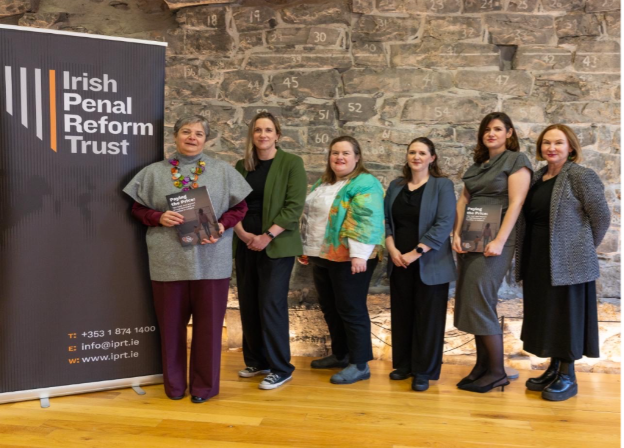
L-R: Koulla Yiasouma, Patricia Keilthy, Dr Naomi Feely, Saoirse Brady, Dr Sara Singleton and Moninne Griffith.
Media Engagement
The report received strong national media attention, helping to amplify its key findings and recommendations. Coverage included features and reporting in the Irish Examiner, RTÉ News and the RTÉ Nine O’Clock News, alongside broadcast discussion on RTÉ Radio 1’s News at One and regional news outlets.
|
|
IPRT Response: A Step Forward for a Proportionate and Humane Penal System
IPRT welcomes the recent recommendations of the Oireachtas Justice Committee on the General Scheme of the Criminal Law and Civil Law (Miscellaneous Provisions) Bill 2025. Many of these recommendations reflect IPRT’s submission and presentation before the Committee earlier this year. We are pleased that the Committee recommended that prison officers will not be armed with incapacitant (pepper) spray, a position IPRT strongly supported from a human rights perspective. Instead, we believe the focus should be on training, de-escalation, and addressing the underlying causes of violence in prison.
The Committee also made positive recommendations on Community Service Orders (CSOs), recognising that they can reduce short-term imprisonment and support rehabilitation - but only when people are given adequate services, supports, and employment opportunities to help them succeed. The report supports the proposal to expand the use of CSOs but highlights the need to consider individual responsibilities such as childcare, employment, or therapeutic appointments, proper resourcing for the Probation Service, and careful monitoring to ensure these measures are effective. Importantly judges will have to give reasons why they would choose prison over a community sentence. IPRT believes these recommendations are an important step forward to ensuring prison is truly a last resort.

|
|
IPRT response to Bail Review
IPRT welcomes the publication of the An Assessment of the Efficacy of Bail Laws in Ireland. In August 2025, we made a detailed submission highlighting the realities faced by people in remand custody, including the high rates of addiction and mental health issues, the conditions in which they are held, and the urgent need for proper supports in the community to ensure that prison is used only as a last resort. More detail is available on the IPRT website.
We particularly welcome the report’s recommendation to introduce an adult bail supervision scheme and the use of positive bail conditions, such as attending counselling, addiction services, or employment programmes. We hope these measures will give people a real opportunity to rebuild their lives.
The report also raises important questions about the use of cash bail, particularly for women and others experiencing homelessness, poverty, or deprivation. IPRT highlighted in our submission that even small amounts - sometimes €100 or less - can prevent someone from being able to meet bail conditions. We also support the report’s call to urgently improve how data on bail is collected, stored, and used, as accurate information is essential for an accountable, modern justice system.
IPRT will continue to engage with policymakers to ensure that these recommendations are implemented effectively, so that the bail system can better support people, reduce unnecessary remand, and prioritise community-based solutions.
|
|
IPRT response to the Office of the Inspector of Prisons Annual Report
Following the publication of the Office of the Inspector of Prisons’ (OIP) Annual Report 2024 and Strategic Plan 2025–2029 on 6 November 2025, IPRT issued a press release calling for immediate action on the inhuman and degrading conditions identified across Irish prisons.
The OIP’s report, drawing on inspections of Midlands Prison, Limerick Women’s Prison, Arbour Hill Prison and Cloverhill Prison, paints a stark picture of prison conditions in 2024. IPRT emphasised that while imprisonment is itself a severe sanction and should always be a last resort, deprivation of liberty must never mean deprivation of dignity. Prison conditions and treatment should not amount to additional punishment.
IPRT welcomed the publication of the Annual Report and Strategic Plan, highlighting the vital role of the OIP as an independent inspectorate in monitoring prison conditions and compliance with human rights standards. However, IPRT expressed deep concern that many of the issues identified as urgent in the report have worsened further in 2025 due to the ongoing overcrowding crisis, leaving even more people detained in inhuman and degrading conditions. Particular alarm was raised at the record number of deaths in custody and at delays between the drafting and publication of inspection reports, underscoring the need for the Inspectorate to be able to publish its findings without delay.
|
|
Youth justice: IPRT before the Oireachtas Justice Committee
In early November, IPRT’s Executive Director, Saoirse Brady, and Legal, Policy and Public Affairs Manager, Niamh McCormack, appeared with colleagues from the sector before the Joint Oireachtas Committee on Justice, Home Affairs and Migration to advocate for a fairer and more compassionate youth justice system.
While welcoming the Children (Amendment) Bill 2024 as a positive step, IPRT highlighted a missed opportunity to raise the age of criminal responsibility in line with European standards and the UN Committee on the Rights of the Child’s recommendation of 14. IPRT stressed that children are not mini adults and that early criminalisation causes lasting harm and undermines rehabilitation.
IPRT urged the Committee to prioritise community-based alternatives to detention, keep rehabilitation and reintegration at the centre of youth justice, and extend youth justice principles to young adults up to 25 to prevent the damaging ‘cliff-edge’ at age 18. IPRT’s overarching message was clear: Ireland needs a youth justice system that protects children, supports rehabilitation, and upholds human rights.

L to R: Sean Egan BL (ICCL, Dr Ian Marder (Maynooth University), Niamh McCormack (PRT), Saoirse Brady (IPRT), Valerie McAllorum Ryan, Claire McEvoy (ICCL), Louise Forde (Brunel University)
|
|
Delivering the Government's Justice Priorities

In November, IPRT was pleased to feature in eolas Magazine with our article “Delivering the Government’s justice priorities” linked here.
In it, we set out the urgent steps the new government should take to improve Ireland’s criminal justice system, including:
- Ratifying the Optional Protocol to the UN Convention Against Torture (OPCAT)
- Advancing community-based sanctions
- Addressing inhuman and degrading conditions in prisons, including overcrowding and poor ventilation
- Implementing the recommendations of the European Committee for the Prevention of Torture
- Improving care for people with mental health issues, women, and mothers in custody
With an overcrowding crisis overwhelming our prisons, the EU Presidency around the corner, and a UN Human Rights Council bid on the horizon, now is the time for the State to take action to meet its human rights obligations and deliver meaningful criminal justice reform.
|
|
Advocacy Engagement
On 11 November, the European Committee for the Prevention of Torture (CPT) presented its findings in Dublin, highlighting serious and longstanding concerns about conditions in Irish places of detention. The CPT’s visit to Ireland in May 2024 was timely and welcome, and its findings are sobering. During the visit, the Committee inspected six prisons and reported good cooperation from Irish authorities in accessing detention facilities. However, it also expressed serious concerns regarding the lack of progress in implementing its previous recommendations. Many of the issues identified - overcrowding, inadequate cell space, use of mattresses on floors, limited privacy in sanitation, and restricted access to family contact reflect conditions observed in 2024, and were only formally published in the CPT report in July 2025.
IPRT has engaged closely with the CPT’s work and echoes its concerns. We have consistently emphasised that responsibility for improving prison conditions cannot rest solely with the Irish Prison Service (IPS). In line with the CPT findings, IPRT advocates that:
- The Government sets maximum occupancy limits for each prison to ensure safe operation, adequate conditions, and access to rehabilitative services.
- A clear, cross-government plan of action is developed to implement the CPT’s recommendations within defined timelines.
- All recommendations from international oversight bodies, including the CPT, are considered and addressed by all appropriate State authorities.
These recommendations and more are published in PIPS 2024. Without decisive, coordinated action, longstanding problems in Irish prisons are unlikely to be resolved, leaving the safety, dignity, and rehabilitation of people in custody at continued risk.
|
|
IPRT in the News
Below are some media highlights featuring IPRT. To read the full list of our media appearances, visit our IPRT in the News webpage.
|
|
It's the Season to Reflect and Celebrate
IPRT colleagues enjoyed a festive visit to Wicklow this month to attend the Shelton Abbey choir carol service. It was uplifting to see the confidence and pride of the choir members, reminding us of the powerful role music and creativity can play in people's progression journey. Our thanks to Governor Joseph Donohue and colleagues for hosting and for demonstrating how supportive environments and meaningful opportunities help people to thrive.
|
|
 |
L to R: Niamh McCormack (IPRT), Saoirse Brady (IPRT), Anne Costello (IPRT) and Governor Joseph Donohue.
|
|
Thank you!
Celebrating 30 Years of IPRT
2025 has been a landmark year for us as we marked our 30 year anniversary - three decades dedicated to fairness, dignity, and human rights in Ireland’s penal system. This year gave us the chance to reflect on our journey, celebrate the people and organisations who’ve stood with us, and share the stories, research, and advocacy milestones that continue to shape our future.
A huge thank you to everyone who engaged with our work this year - whether by attending events, sharing your expertise, amplifying our advocacy, or simply staying informed. Your support drives our mission and inspires us to pursue lasting, rights-based change.
Watch the highlights from our 30-year celebration here.
We couldn’t have done it without our supporters. Whether you donated, shared our messages, gave feedback, or cheered us on from afar, your involvement makes a real difference. We love hearing from you - feel free to share feedback anytime and follow us on social media for the latest updates.
Holiday Closure: The IPRT office will close at 5 pm on Tuesday, 23 December 2025, and reopen at 9 am on Friday, 2 January 2026. You can email us at info@iprt.ie, and we’ll get back to you when we return.
 |
|
|
Add your voice - become a Friend or Member
|
|
|
IPRT relies on a network of committed supporters who share our vision for change. By becoming a Friend or Member of IPRT, you add your voice to our campaign for a more humane and equitable penal system.
To find out more about supporting our work, please visit our Friends or Membership pages.
|
|
|
|
|